Calculites additus
Set number: 2996
-
1
-
2
-
3
-
4
-
5
-
6
-
7
-
8
-
9
-
10
10µm
Set number: 3011
-
1
-
2
-
3
-
4
-
5
-
6
10µm
Phanulithus additus Wind & Wise in Wise & Wind, 1977
Species of Calculites are constructed of a narrow outer wall and five central crystalline blocks that support a large hollow distal process. The process is supported by six to nine struts, which produce depressions between adjacent struts. The scanning electron microscope images of the holotype illustrated in Plate 30, Figure 2, of Wise & Wind (1977) provide the best example of this detailed structure.
The separation of the suture lines of the axial crystalline blocks is most likely related to the presence of a large, hollow distal process.
In plan view under crossed polars, the outer wall and the crystalline blocks of this holococcolith display first-order greyish-white to yellowish-brown interference colours.
Calculites additus exhibits parallel extinction (extinction angle 0°) and length-slow (+) elongation in its natural position.
Perch-Nielsen, K. 1984. Validation of new combinations. INA Newsletter. 6(1): 42-46.
Wise, S. W. & Wind, F. H. 1977. Mesozoic and Cenozoic calcareous nannofossils recovered by DSDP Leg 36 drilling on the Falkland Plateau, south-west Atlantic sector of the Southern Ocean. Initial Reports of the Deep Sea Drilling Project. 36: 269-491.
Holotype
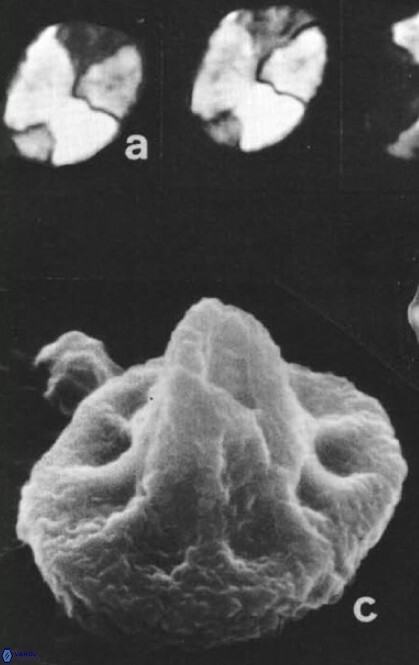
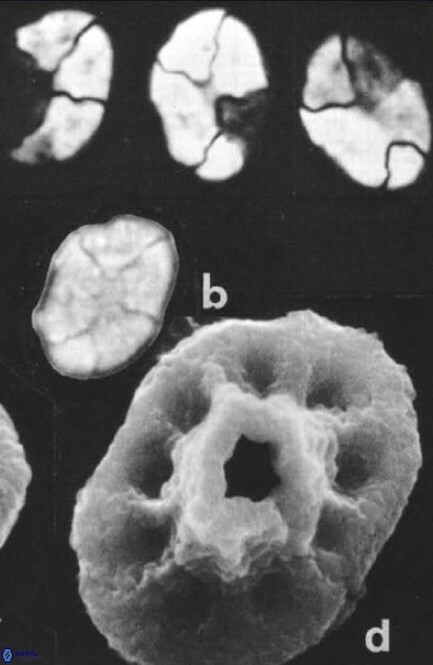
Phanulithus additus
Wind & Wise in Wise & Wind, 1977
Early Maastrichtian
DSDP Leg 36, Site 327A, The Maurice Ewing Bank, Falkland Plateau