Calculites stavrotos
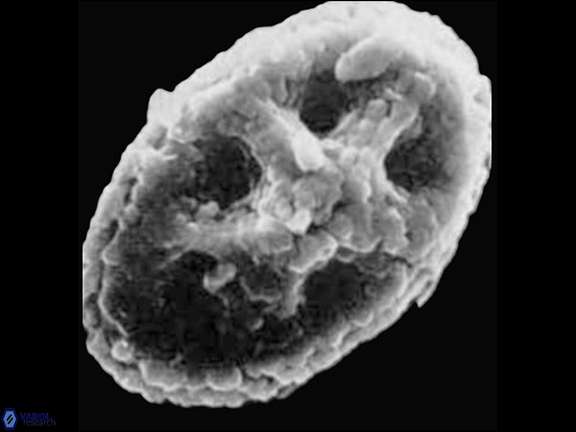
SEM photo of Calculites stavrotos from Hatter & Wise, 1980 (Pl. 27, Fig. 9)
Set number: 3001
-
1
-
2
-
3
-
4
-
5
-
6
-
7
-
8
-
9
-
10
-
11
-
12
-
13
-
14
-
15
10µm
Calculites stavrotos Varol, in prep.
From the Greek stavrotos, meaning “cross”, referring to the cross-forming struts that support the distal process.
Elliptical species of Calculites are constructed of a narrow outer wall and four central crystalline blocks that support a large, solid distal process, round in cross-section. The distal process is supported by four to five struts, which produce large depressions between adjacent struts. The scanning electron microscope image illustrated in Plate 27, Figure 9, of Hattner & Wise (1980) provides the best example of this detailed structure.
The sutures between the crystalline blocks meet at the centre, forming a cross that is rotated slightly relative to the long axis of the ellipse.
In plan view under crossed polars, the outer wall and the crystalline blocks display first-order whitish-yellow interference colours, whereas the distal process exhibits second-order bluish-red interference colours.
Calculites stavrotos exhibits parallel extinction (extinction angle 0°) and length-slow (+) elongation in its natural position.
Hattner, J. G. & Wise, S. W. 1980. Upper Cretaceous calcareous nannofossil biostratigraphy of South Carolina. South Carolina Geology 24: 41-117.