Calculites rhachis
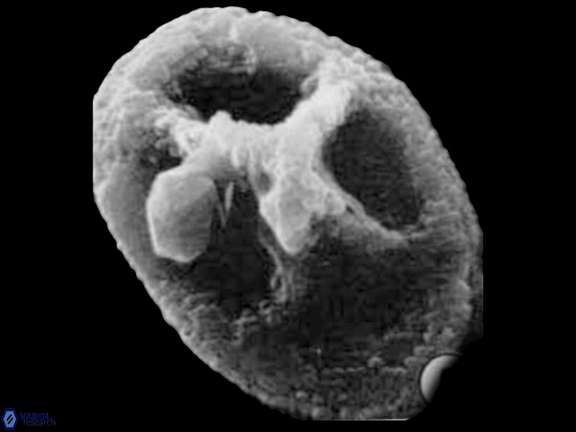
SEM photo of Calculites rhachis from Hatter & Wise, 1980 (Pl. 27, Fig. 6)
Set number: 3000
-
1
-
2
-
3
-
4
-
5
-
6
-
7
-
8
-
9
-
10
-
11
-
12
-
13
-
14
10µm
Set number: 3006
-
1
-
2
-
3
-
4
-
5
-
6
-
7
-
8
10µm
Calculites rhachis Varol, in prep.
From the Greek rhachis, meaning “ridge”, referring to the distal ridges.
Elliptical species of Calculites are constructed of a narrow outer wall and four central crystalline blocks that support a very narrow, solid distal process. The process is supported by four diagonal struts, which produce large depressions between adjacent struts. The scanning electron microscope image illustrated in Plate 27, Figure 6, of Hattner & Wise (1980) provides the best example of this detailed structure.
The diagonal sutures on the struts extend from the centre of the holococcolith between the crystalline blocks and may curve gently towards the periphery.
In plan view under crossed polars, the outer wall and the crystalline blocks display first-order whitish-yellow interference colours. Calculites rhachis exhibits parallel extinction (extinction angle 0°) and length-slow (+) elongation in its natural position.
Hattner, J. G. & Wise, S. W. 1980. Upper Cretaceous calcareous nannofossil biostratigraphy of South Carolina. South Carolina Geology 24: 41-117.