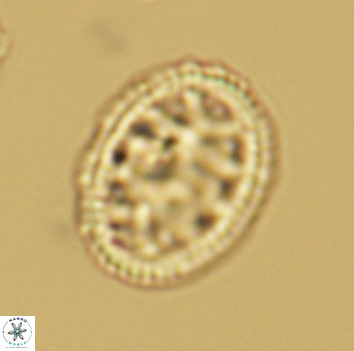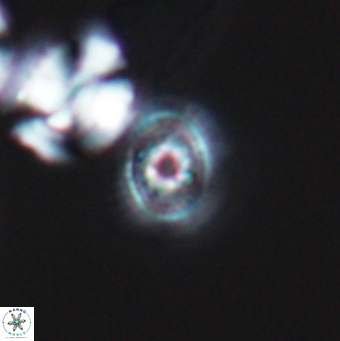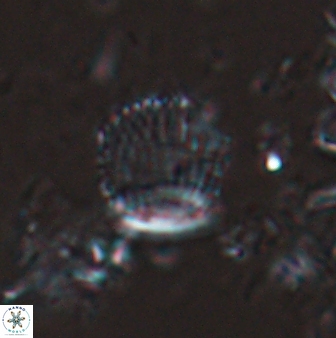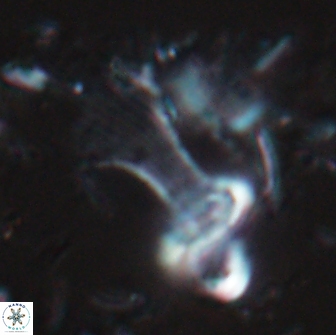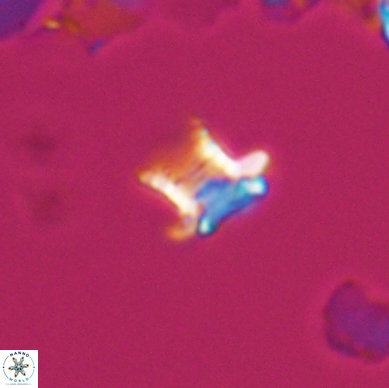
Podorhabdus Noël, 1965
Axopodorhabdus Wind and Wise in Wise and Wind, 1977
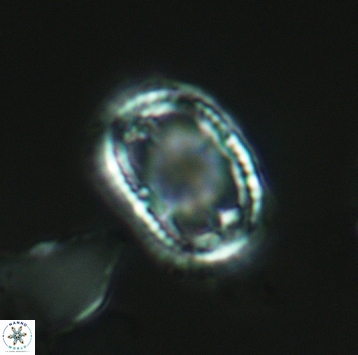
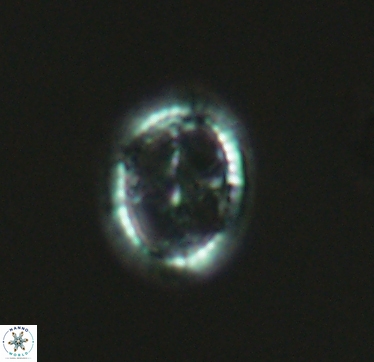
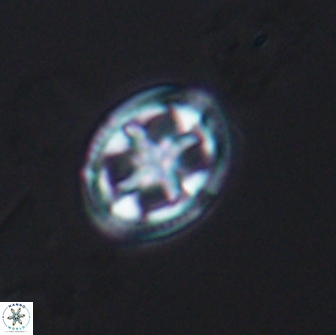
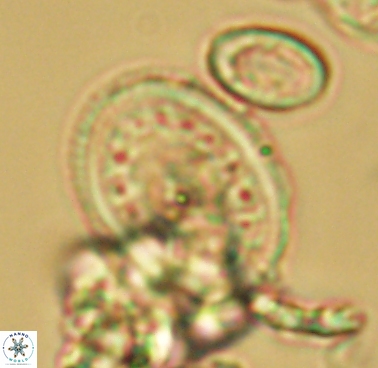
The elliptical to circular placolith consists of a distal shield composed of non-imbricate segments, a proximal shield, and a tube cycle surrounding a central area spanned by a cross, bar, or perforated structure that supports the distal process.
The distal shield in Podorhabdaceae is in constant extinction because the optic axis (c-axis) is perpendicular to the microscope stage, whereas the proximal shield and the tube cycle exhibit interference colours with inclined extinction.
Podorhabdaceae and Biscutaceae comprise similarly constructed placoliths, characterised by a distal shield with non-imbricate segments, a proximal shield, and a tube cycle surrounding a central area spanned by a cross, bar, or perforated structure. Strictly speaking, they may be regarded as synonymous.
In this work, taxa bearing a distal process are assigned to Podorhabdaceae, whereas members of Biscutaceae lack a distal process.
Noël, D. 1965. Sur les Coccolithes du Jurassique Européen et d'Afrique du Nord. Essai de classification des coccolithes fossiles. Éditions du Centre National de la Recherche Scientifique, Paris. 1-129.
Wise, S. W. & Wind, F. H. 1977. Mesozoic and Cenozoic calcareous nannofossils recovered by DSDP Leg 36 drilling on the Falkland Plateau, south-west Atlantic sector of the Southern Ocean. Initial Reports of the Deep Sea Drilling Project. 36: 269-491.