Watznaueria angustoralis
Set number: 1764
-
1
-
2
-
3
-
4
-
5
-
6
-
7
-
8
-
9
-
10
-
11
-
12
-
13
-
14
-
15
-
16
-
17
-
18
-
19
-
20
-
21
-
22
-
23
-
24
-
25
-
26
-
27
-
28
-
29
-
30
-
31
-
32
10µm
In the mobile mobile mount
Set number: 1763
-
1
-
2
-
3
-
4
-
5
-
6
-
7
-
8
-
9
-
10
-
11
-
12
-
13
-
14
-
15
-
16
10µm
Set number: 1762
-
1
-
2
-
3
-
4
-
5
-
6
-
7
-
8
-
9
-
10
-
11
-
12
-
13
-
14
-
15
-
16
10µm
Set number: 1761
-
1
-
2
-
3
-
4
-
5
-
6
-
7
-
8
-
9
-
10
-
11
10µm
Set number: 1772
-
1
-
2
-
3
-
4
-
5
-
6
-
7
-
8
-
9
-
10
-
11
-
12
10µm
Watznaueria angustoralis Reinhardt, 1964
Emended: In this study, subcircular specimens of Watznaueria measuring less than 10.0 µm in length and characterised by a closed central area are assigned to Watznaueria angustoralis.
Extinction angles measured from the distal side are typically approximately 73° in the shields and approximately 60° in the tube cycles. The locking cycle remains in constant extinction, forming a narrow dim suture between the shield and tube cycle.
Watznaueria angustoralis is distinguished from Watznaueria cauveryensis by its smaller size (<10 µm). The two species share similar extinction characteristics but differ in the optical properties of the locking cycle. In Watznaueria angustoralis, the locking cycle remains in constant extinction and is expressed as a narrow, dim suture separating the shield from the tube cycle. In Watznaueria cauveryensis, the locking cycle exhibits interference colours, producing a transitional boundary between the tube cycle and the shield.
It is further distinguished from similarly sized Watznaueria deflandrei by its subcircular outline and by the measurable extinction angle in the tube cycles. In Watznaueria angustoralis, the extinction angle in the tube cycles is approximately 60° on the distal side. In contrast, this angle cannot be directly measured in Watznaueria deflandrei because its constituent segments are obliquely oriented; instead, the apparent angle between extinction directions is approximately 63°, corresponding to an obliquity of approximately 27°.
Reinhardt, P. 1964. Einige Kalkflagellaten-Gattungen (Coccolithophoriden, Coccolithineen) aus dem Mesozoikum Deutschlands. - Monatsberichteder Deutschen Akademieder Wissenschaftenzu Berlin. 6: 749-759.
Holotype
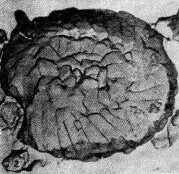
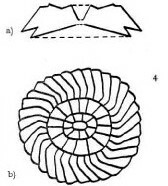
Watznaueria angustoralis
Reinhardt, 1964
Late Turonian
Germany