Watznaueria coronata
Set number: 3228
-
1
-
2
-
3
-
4
-
5
-
6
-
7
-
8
-
9
-
10
10µm
Set number: 3236
-
1
-
2
-
3
-
4
-
5
-
6
-
7
-
8
-
9
10µm
Set number: 3237
-
1
-
2
-
3
-
4
-
5
-
6
10µm
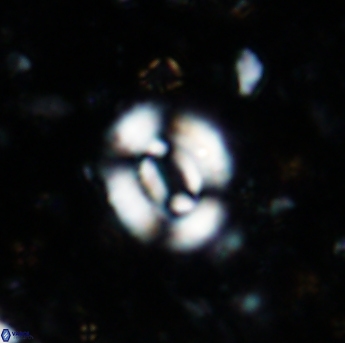
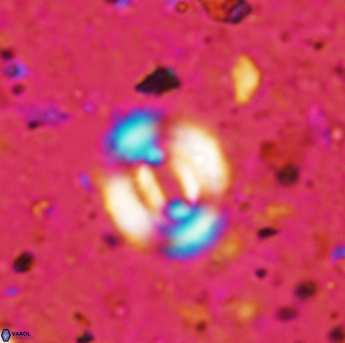
Coccolithus coronatus Gartner, 1968
Elliptical species of Watznaueria are characterised by single-tiered distal and proximal shields, narrow tube cycles, and a narrow, elongate central opening devoid of central-area structures. The central opening less than 1.0 μm in width and has an ellipticity greater than 2.
The shields, as well as the tube cycles, display first-order white interference colours with inclined extinction lines and length-fast (–) elongation. In distal view, the extinction angles in the shields are approximately 78°. This angle cannot be directly measured in the tube cycles due to the oblique orientation of their constituent elements; however, the apparent angle between extinction lines in the tube cycle is about 73°, corresponding to an obliquity of about 17°. Distinguishing the inner from the outer tube cycle is difficult under all illumination conditions. The locking cycle remains in constant extinction, forming a narrow dim suture between the shield and tube cycle.
Watznaueria coronata differs from Watznaueria ovata and Watznaueria fossacincta in having a narrow, elongate central opening, whereas the latter species possess circular to elliptical central openings.
Bukry, D. 1969. Upper Cretaceous coccoliths from Texas and Europe. University of Kansas Paleontological Contributions, Articles 51 (Protista 2): 1-79.
Gartner, S., 1968. Coccoliths and related calcareous nannofossils from Upper Cretaceous deposits of Texas and Arkansas. University of Kansas Paleontological Contributions, Articles 48 (Protista 1), 1-56.
Holotype
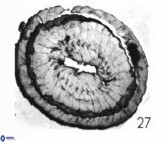
Coccolithus coronatus
Gartner, 1968
Cenomanian - Turonian
Eagle Ford Shale, Texas, USA